

A Field Guide to the Future(s)
An inside look at the futurist toolbox.


A Field Guide to the Future(s)
When we talk about the future, many people imagine this big, monolithic “thing” that is written in stone.
But this would be dull. The world is a far more interesting place.
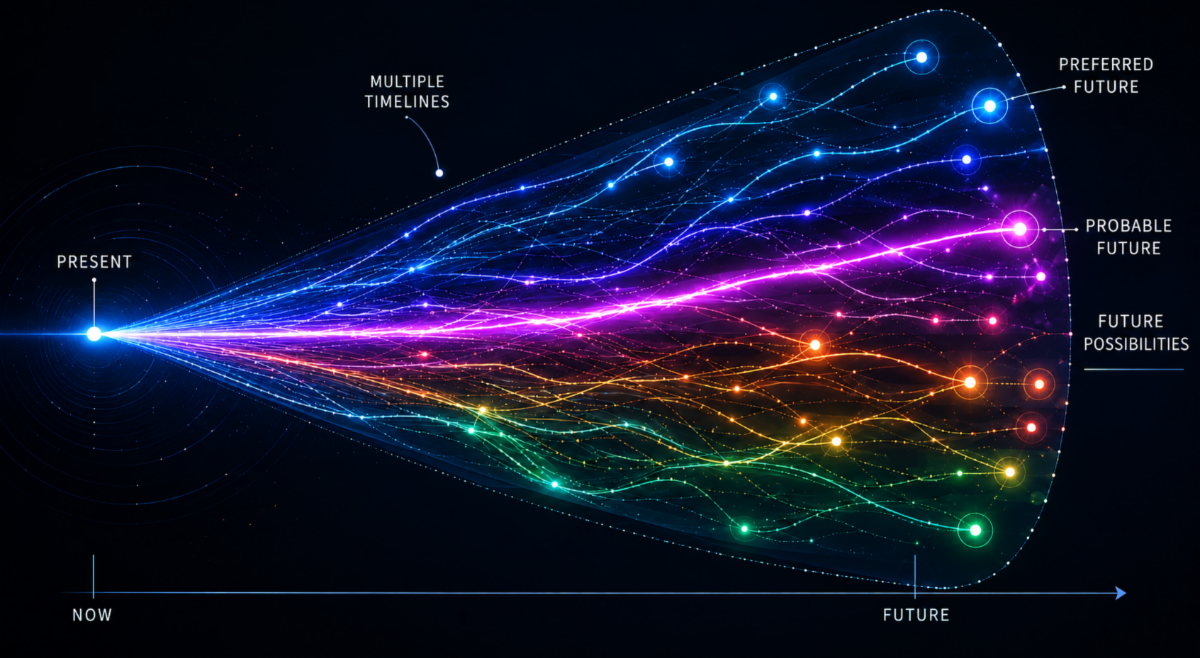
The “future” doesn’t exist -- at least in a singular sense. It is far more helpful to think of it as an ecosystem of sorts.
Strategic Foresight is an exploration of the many types of future that we can experience.
The Cone of Possibility (see above image, sourced from KnowledgeWorks) is an excellent way to map out what the future looks like in practice. It starts with a single perspective that broadens over time.
There are a few different varieties of the future. Each can be explored with a different set of tools.
The Probable Future is what you’ll likely run into when you ask ChatGPT or a predictions market about what happens next. This is the most likely outcome of current trends. It’s what everyone expects.
There are no surprises here, it’s mostly just linear forecasting.
This is surrounded by a zone of uncertainty, where we can find Plausible Futures. These are things that could happen under the right conditions. Change a variable or an assumption, and you have a whole new future! This is what futurists explore when doing scenario planning. By looking at a range of potential outcomes, people and organizations can respond faster and better to a changing world.
The next layer out is the Wild Card Future, the so-called “Black Swans” that are unexpected and come out of nowhere. The best way to scan for these is to track what futurists call “weak signals”. Horizon scanning is a ton of fun. Prepare to be surprised!
In between the Plausible and the Wild Card is the Preferable Future. This is the future that you want to live in. It’s out there, but you need to look for it.
When I was just getting started, I thought that prediction was a superpower. If it was possible to predict things accurately, you could dodge bullets and make millions in the stock market. So, I spent years trying to figure it out.
But the world is bigger than you might expect. That’s why I now believe that creativity and visioning are more important than forecasting. These are better tools for finding real solutions.
Instead of worrying about “what could possibly go wrong”, think about “what could possibly go right”. And then put together a plan for making it happen.
By making enough of the right small decisions overtime, you can shift from the probable future to your best future.
Bonus: Applying This to Investing
As we know from experience, anything can happen with the markets these days. The 4 P’s (probable, plausible, possible, preferred) are easily integrated into portfolio management.
The probable future is all about finding your core holdings and high conviction positions. For many, this might include technology stocks and index funds.
The plausible future is why we diversify. This involves not “putting all your eggs in one basket”.
The possible future is about managing tail risk. It’s why we might hedge a portfolio with options or buy life insurance.
And finally, the preferred future can cover any number of things, from socially responsible investing to charitable giving and venture capital.
If done well, investing becomes a tool for shaping outcomes.
Next Month: Quantum Jumping Made Easy
Copyright ©️ 2026. All Rights Reserved.
About the author

Disclosure
Information contained herein is for educational purposes only and is not to be considered a recommendation to buy or sell any security or investment advice. Securities listed herein are for illustrative purposes only and are not to be considered a recommendation. The author and StratFI clients may hold positions in securities mentioned.
Do you want monthly
Foresight straight to your inbox?
Straightforward commentary, strategic perspectives, and no noise — just one email a month to help you think smarter about your financial future.
Related articles
Explore timely insights and thoughtful perspectives from James Lee and StratFI. Each article is designed to help you cut through the noise, understand the bigger picture, and invest with confidence.
.png)
Straightforward commentary, strategic perspectives, and no noise, just one email a month to help you think smarter about your financial future.