

Beyond Capitalism
Capitalism has long defined Western society, but what happens when its foundations begin to crack? Can we imagine a better system for managing the global economy—and what it might look like?

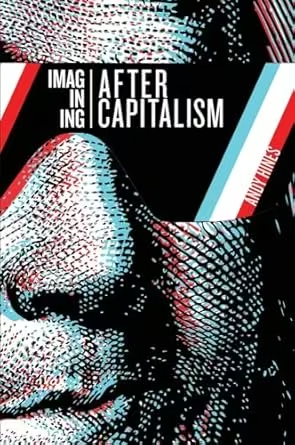
Capitalism has long defined Western society, but what happens when its foundations begin to crack? Can we imagine a better system for managing the global economy—and what it might look like?
Futurist Andy Hines tackles these questions head-on in his new book Imagining After Capitalism, using the tools of foresight to chart possible paths beyond today’s market-driven paradigm.
While investors tend to think in quarters and cycles, Hines and other futurists think in horizons—phases of transformation that can stretch across decades.
At the heart of his analysis lies the Three Horizons Model, originally developed by Bill Sharpe of the International Futures Forum. The model helps us visualize how dominant systems decline and give way to new ones.
- Horizon 1 is the prevailing system—in this case, late-stage neoliberal capitalism. Its institutions still set the rules, but internal contradictions are multiplying.
- Horizon 2 enters a turbulent transition zone, where the old order fragments and experimental models begin to emerge.
- Horizon 3 is the next system—the mature successor that reflects the values, technologies, and institutions of a new era.
According to Hines, the core assumptions of capitalism—endless growth, consumption as identity, and shareholder dominance—are colliding with powerful headwinds: widening inequality, job displacement from automation, ecological strain, slowing productivity, eroding institutional trust, and shifting cultural values. These forces don’t end capitalism overnight, but they are pushing society into Horizon 2, a phase of creative adaptation.
From this transition, Hines outlines three possible futures “after capitalism,” each shaped by a different organizing principle:
Circular Commons (Environment-First)
In this scenario, the organizing principle of the global economy shifts from extraction to regeneration. The Circular Commons world is built around the idea that prosperity depends not on how much we consume, but on how intelligently we reuse, share, and restore.
Economic value becomes inseparable from ecological stewardship.
Instead of linear supply chains—take, make, waste—resources circulate in closed loops. Products are designed for disassembly; materials retain ownership tags that trace their origin, composition, and lifecycle. Waste becomes feedstock for the next process. Cities evolve into ecosystems that manage water, energy, and data as shared commons rather than privatized assets.
Governance also changes. National policies give way to localized networks of accountability, where cooperatives, regional alliances, and community-owned utilities coordinate production and resource management. Data is treated as a public good. Intellectual property, once a moat, increasingly becomes a shared infrastructure for collective innovation.
The triggers for this transition are already in motion: binding climate agreements, carbon pricing regimes, and the rising cost of resource extraction. Supply-chain disruptions and environmental shocks accelerate the push toward circular design. As sustainability becomes not just moral but financial necessity, corporations are forced to internalize environmental costs that were once externalized to society.
Non-Workers’ Paradise (Society-First)
In this future, the defining feature of capitalism—work as the gateway to income—begins to dissolve. Automation, artificial intelligence, and robotics steadily erode the link between human labor and economic production. As machines perform more of what people once did, societies are forced to rethink the purpose of work, the distribution of income, and the meaning of productivity itself.
This transition doesn’t arrive all at once. It begins with sectors where automation reaches critical mass—logistics, retail, transportation, and even professional services. Displaced workers pressure governments to act, prompting experiments in universal basic income, portable benefits, and shorter workweeks. As these pilots expand and succeed, the old social contract—“you work, therefore you earn”—is replaced by a new logic: every citizen participates in economic life through consumption, caregiving, creativity, and civic contribution, not merely employment.
The Non-Workers’ Paradise is not about idleness, but re-valuation—a shift from economic activity defined by wage labor to one centered on human flourishing. Learning, caregiving, mentoring, and artistic creation become recognized as productive work. National well-being is measured less by GDP and more by health, education, community cohesion, and psychological resilience.
Tech-Led Abundance (Technology-First)
In this scenario, technology doesn’t just improve capitalism—it renders many of its old constraints obsolete. Breakthroughs in artificial intelligence, robotics, biotechnology, and clean energy drive marginal costs for production and distribution toward zero. Manufacturing becomes hyper-efficient, digital networks automate resource allocation, and synthetic biology blurs the line between information and matter.
As these forces converge, platforms that once competed for profit begin to operate more like public utilities, providing near-universal access to information, energy, and materials at minimal cost. Ownership gives way to access; scarcity gives way to coordination. In this world, value no longer flows primarily from capital accumulation but from the architecture of trust—the systems that verify authenticity, govern shared infrastructure, and maintain social legitimacy amid abundance.
The triggers for this transition are already visible: rapid advances in generative AI, molecular design, autonomous logistics, and decentralized energy. Each innovation pushes a piece of the economy closer to “post-scarcity” conditions. Over time, these technologies intersect to create a self-reinforcing cycle of abundance and democratized production.
Scenarios don’t come with any guarantees, think of them as useful “toys for the mind” to help us learn about possible futures.
Hines’s message is clear: these aren’t utopian dreams—they’re competing trajectories already unfolding. Imagining After Capitalism is thoroughly researched and visionary, the most provocative book about understanding “the big picture” that I’ve read this year.
Copyright ©️ 2026. All Rights Reserved.
About the author
Disclosure
Information contained herein is for educational purposes only and is not to be considered a recommendation to buy or sell any security or investment advice. Securities listed herein are for illustrative purposes only and are not to be considered a recommendation. The author and StratFI clients may hold positions in securities mentioned.
Do you want monthly
Foresight straight to your inbox?
Straightforward commentary, strategic perspectives, and no noise — just one email a month to help you think smarter about your financial future.
Related articles
Explore timely insights and thoughtful perspectives from James Lee and StratFI. Each article is designed to help you cut through the noise, understand the bigger picture, and invest with confidence.


Straightforward commentary, strategic perspectives, and no noise, just one email a month to help you think smarter about your financial future.